

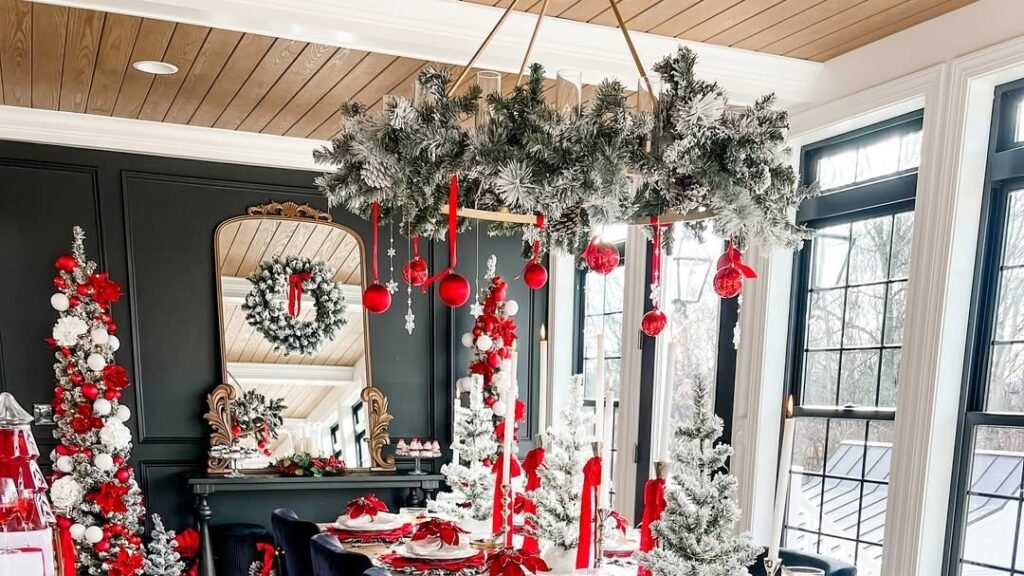
A chandelier usually just lights the room while the tree gets all the attention. These 20 Christmas chandelier decor ideas flip that: the fixture itself gets dressed in greenery, ribbon, and ornaments, so it becomes the thing people look up and notice first.
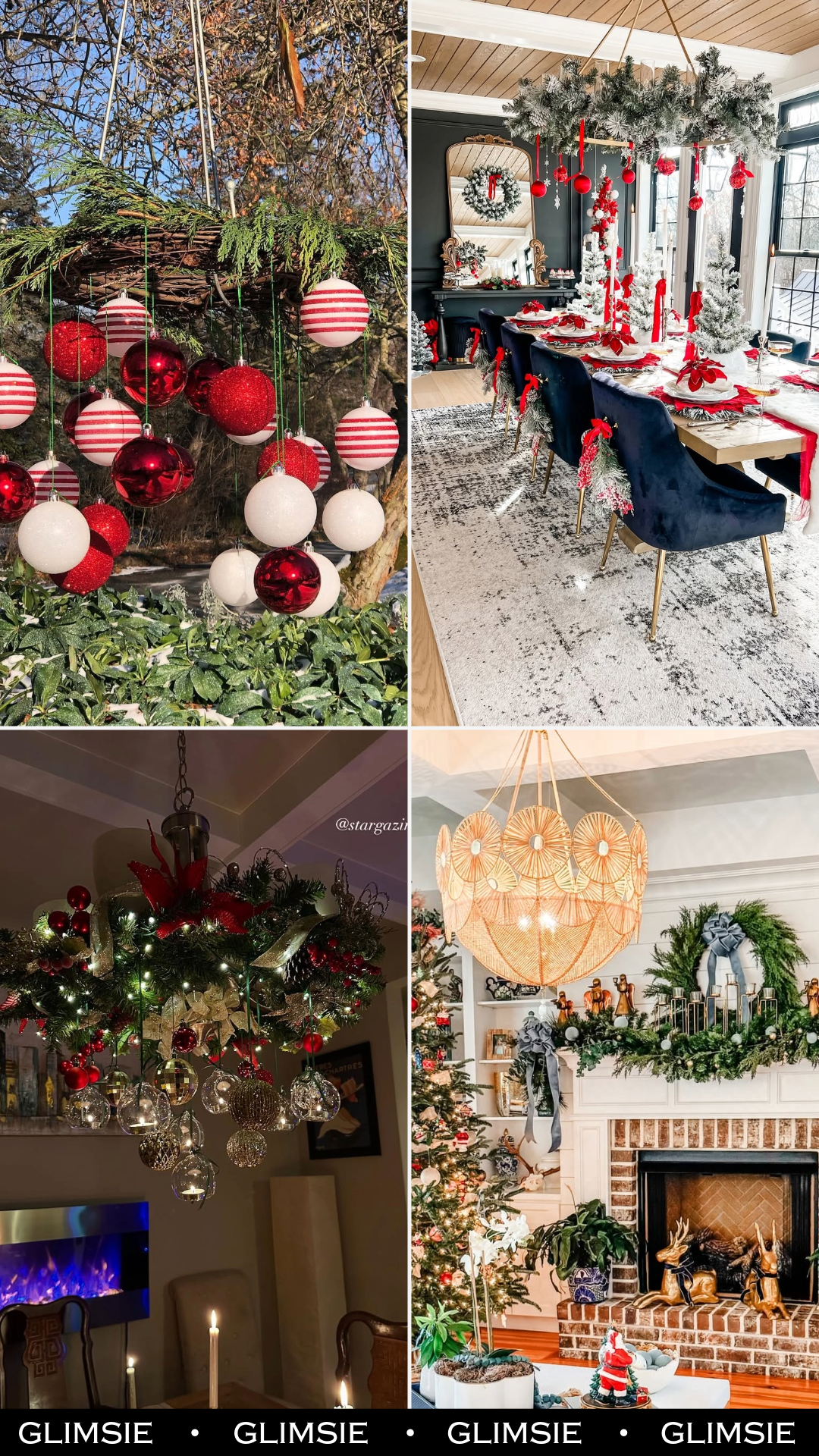
20 Christmas Chandelier Decor Ideas for Making the Light Fixture the Main Event
Most holiday decorating starts and ends with the tree, and the chandelier just hangs there doing its job. That’s a missed spot, because a chandelier sits at eye level with everyone’s gaze the second they walk into a dining room, and it’s already got the arms and rings built in to hold greenery and ornaments without you building anything from scratch.
These ideas cover the whole range, from a single ribbon tied on each arm to a full greenery cloud with ornaments hanging underneath. Pick the one that matches how much time you actually want to spend on a ladder.
The Move for a Ceiling That’s Basically Bare
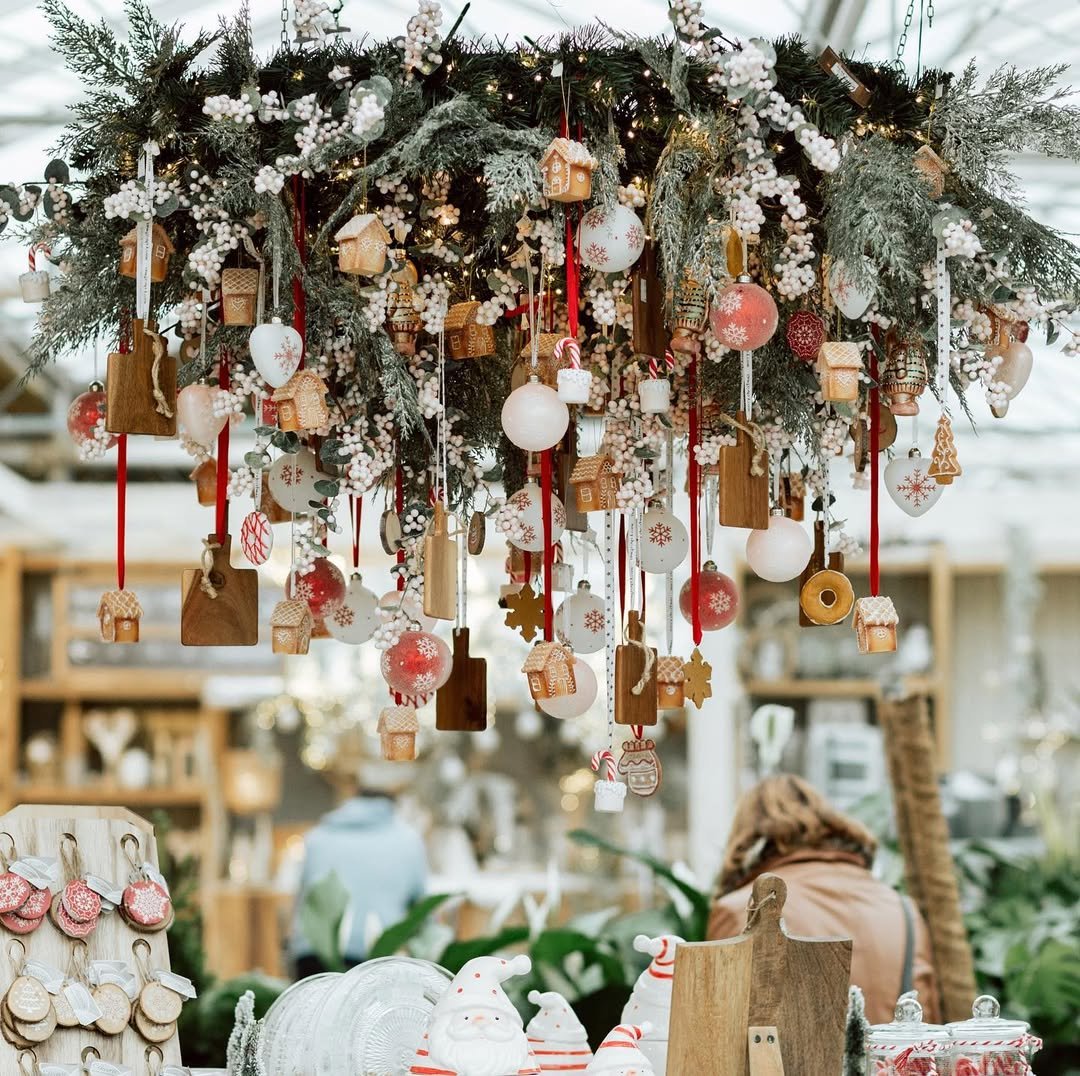
Pine, white berries, and a mix of gingerbread houses and glass balls get wired straight into a flat rectangular frame here, so the whole thing reads like a floating garden instead of a light fixture. It works because the ornaments hang at different lengths on red ribbon, giving it depth instead of one flat plane of green. If your ceiling has an exposed beam or a plain track you can wire to, this is the way to make it look intentional instead of overlooked. Copy the mixed-length hanging trick and skip the uniform-drop look that reads more like a store display.
Two Bows Instead of a Full Wrap
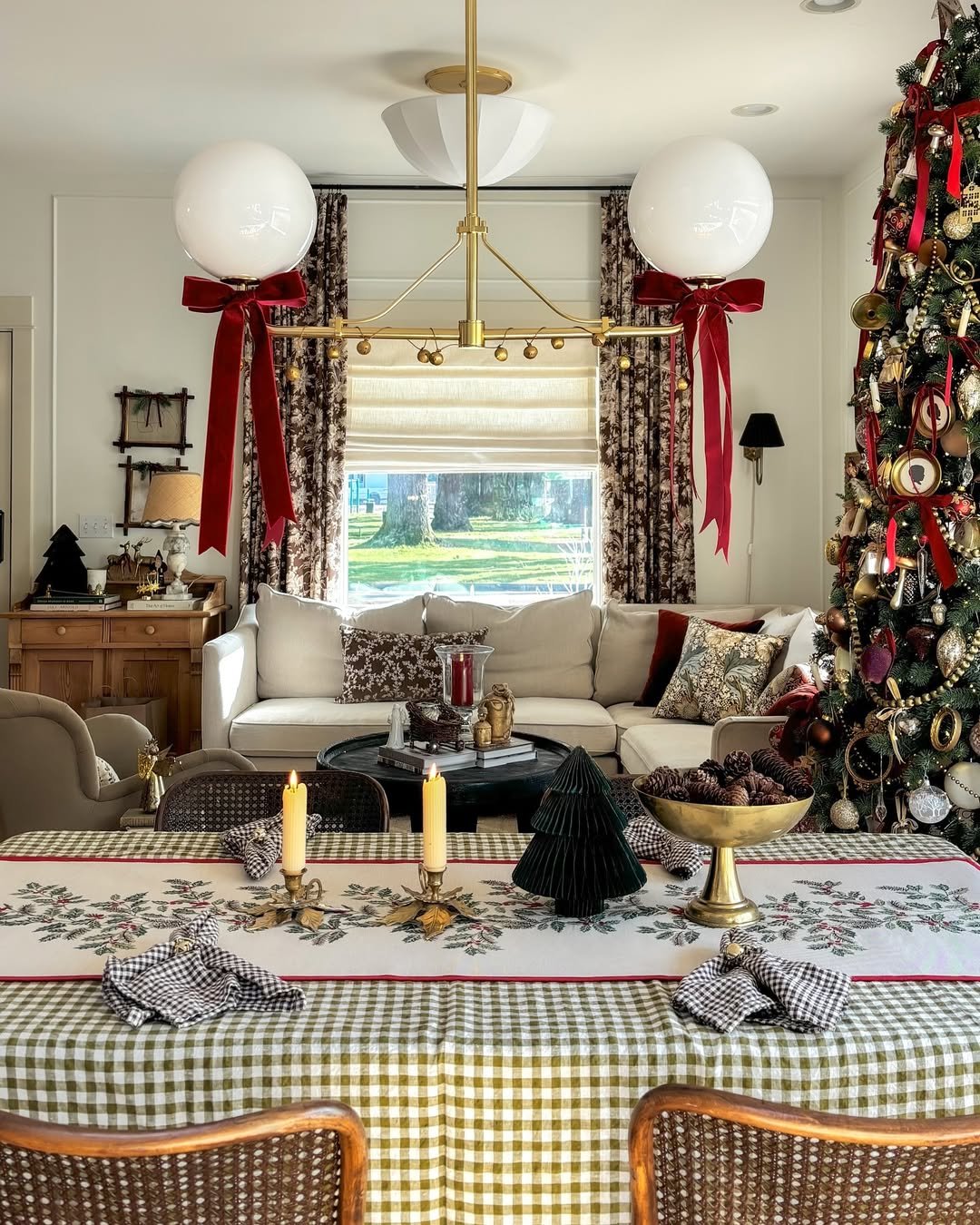
Big red velvet bows tied at the top of each arm turn a plain brass and glass-globe pendant into a Christmas piece without touching the globes themselves. It works because the bows sit at the connection points, the spot your eye already goes to first on a fixture like this, so two bows do the job that a full wrap of ribbon would otherwise need. A small gold bell garland strung along the bottom rail adds the sound and shine without adding bulk. This is the fastest option on the whole list if your chandelier already has a simple, modern shape.
Dark Ornaments for a Rustic Fixture
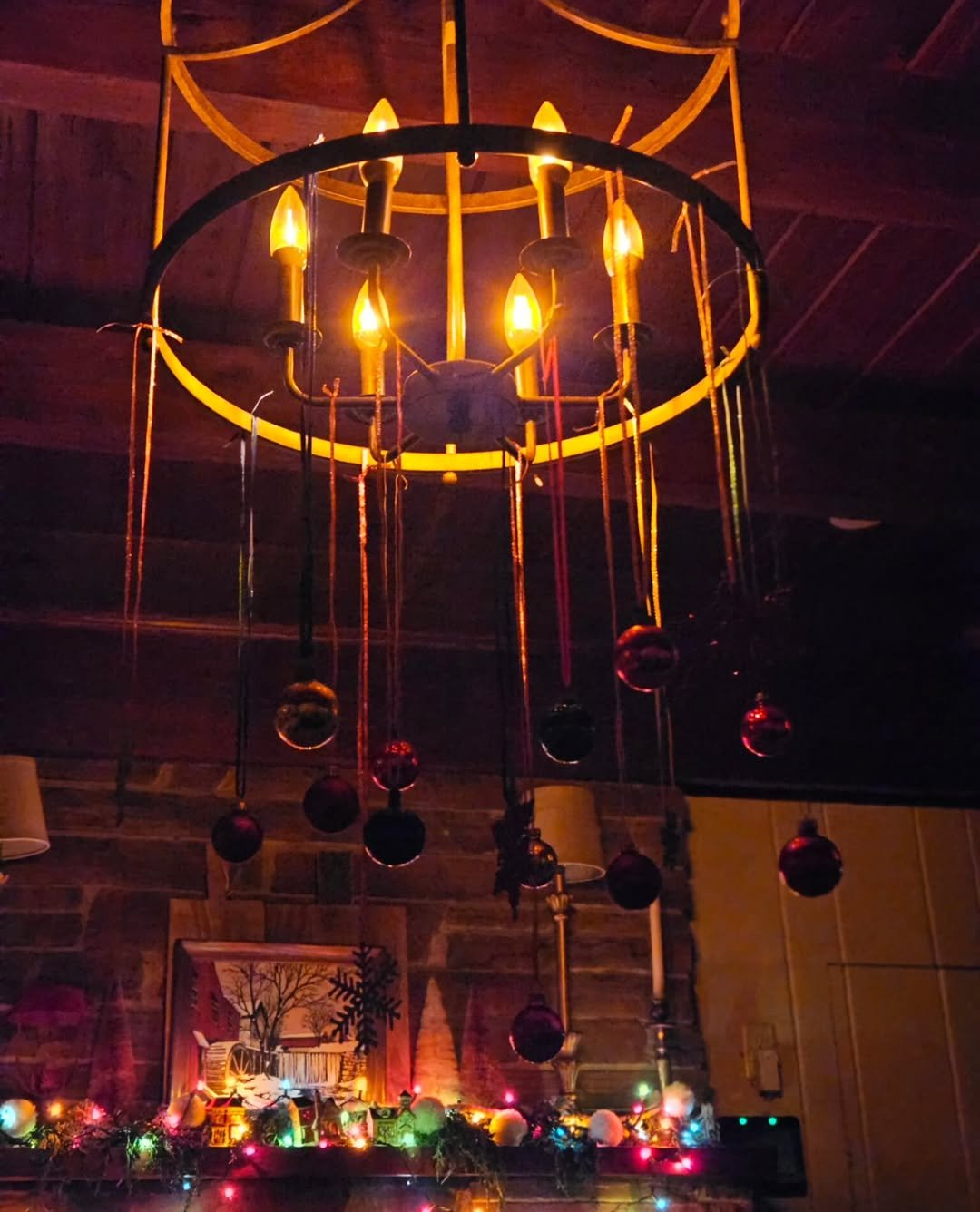
Deep red and burgundy glass balls hang on mismatched ribbon lengths straight off this wood and iron ring chandelier, no greenery at all. It works because the dark, matte ornaments don’t compete with the warm candlelight glow, they just catch it. Cabin and farmhouse chandeliers usually get skipped at Christmas because people assume they need a full pine wrap, but a handful of hanging balls in a color that matches the wood tone does more with less. Try burgundy or bronze on stained wood, not bright red, so the whole thing stays moody instead of loud.
The Garland That Skips Green Entirely
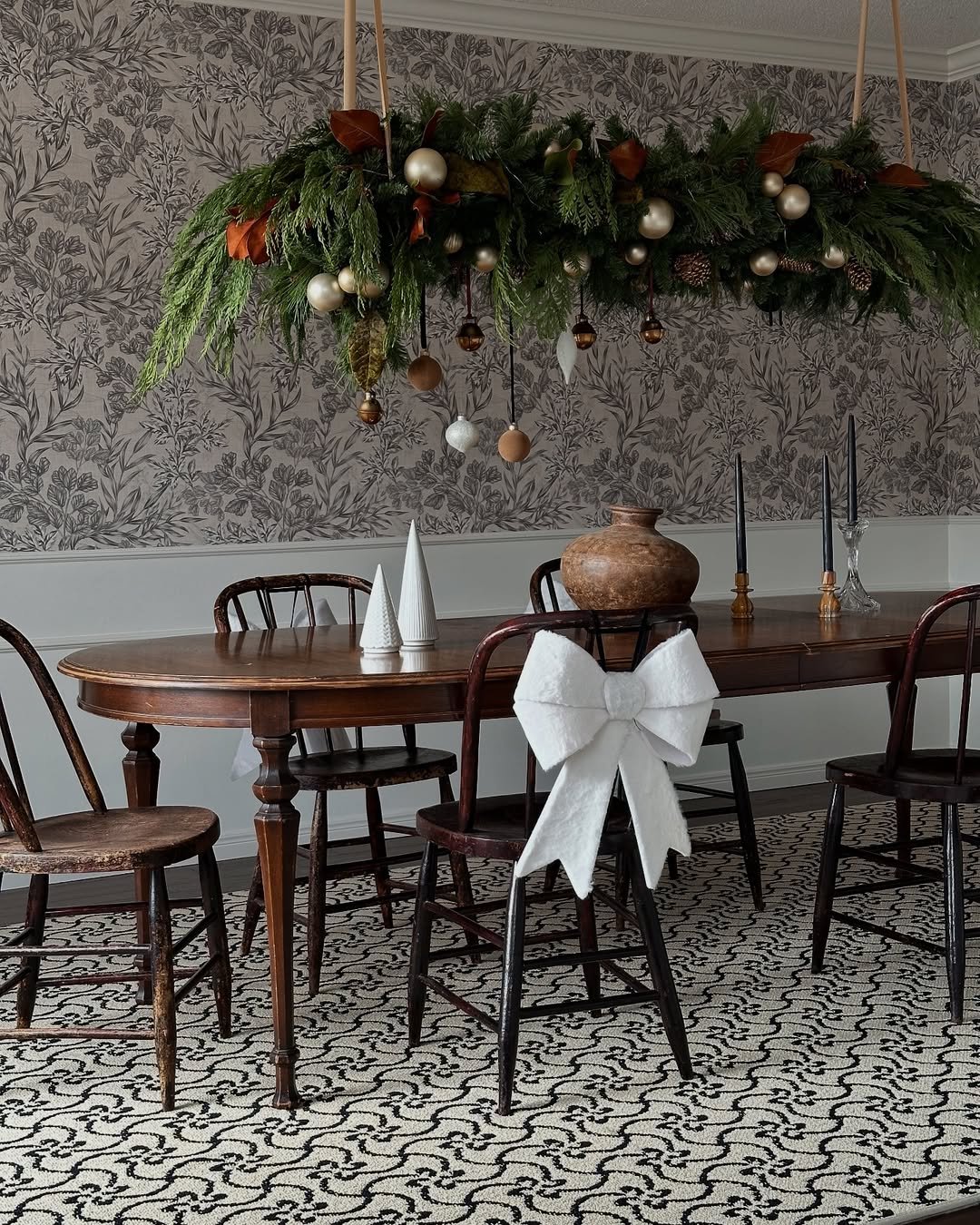
Cedar and pine form the base here, but the standout move is the dried magnolia leaves and gold ornaments woven through, dropped on long black ribbon at different heights below the greenery. It works because the rust-brown leaves and warm gold balls keep the whole thing out of typical red-and-green territory, so it reads as fall carrying into winter rather than a Christmas costume. If you already did a magnolia leaf garland for Thanksgiving, this is how you carry that same material into December instead of starting over. Pin the ornament ribbons at uneven lengths so nothing lines up in a row.
Bright Color for a Room That Isn’t Formal
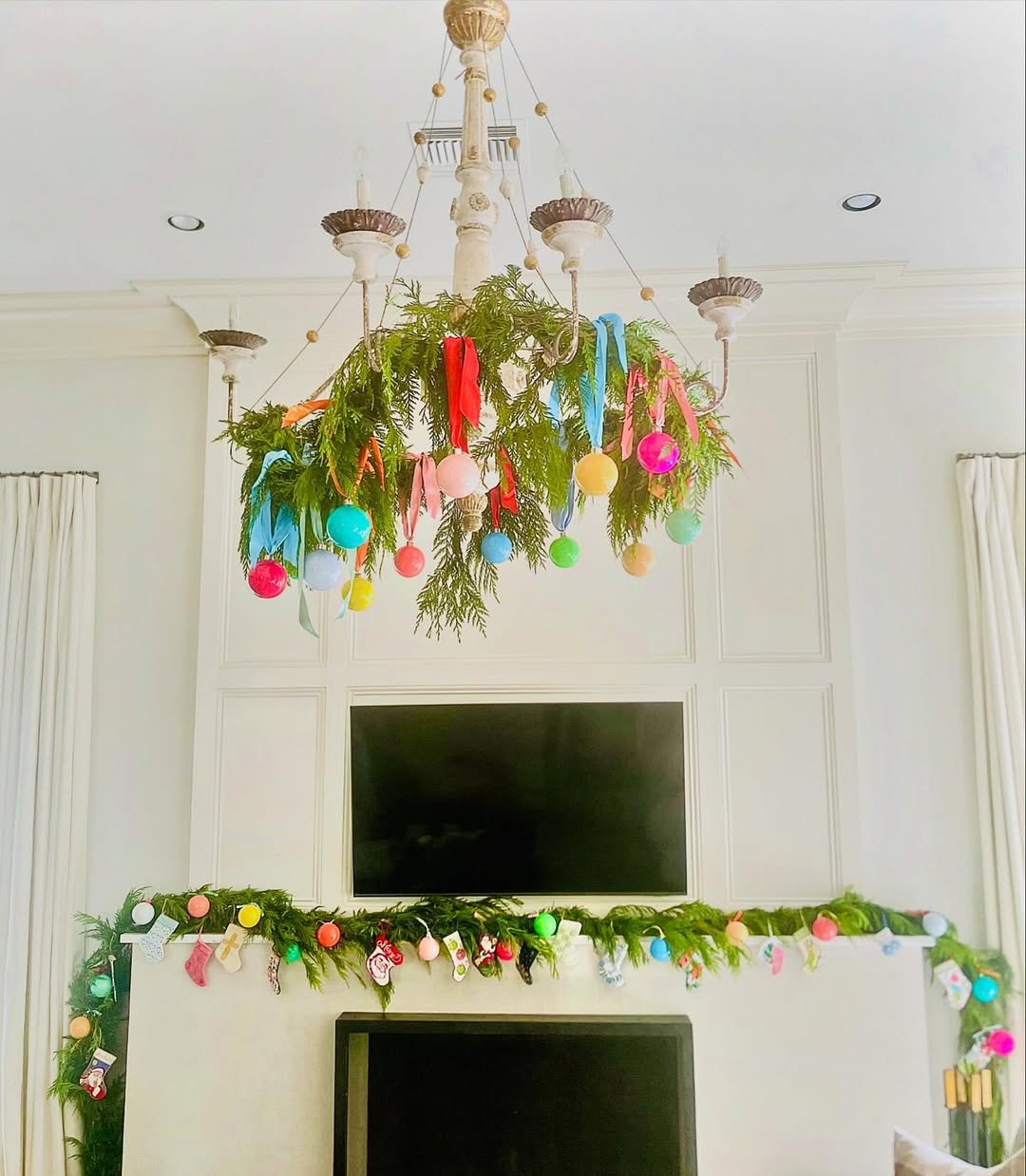
Cypress greenery gets hung with ribbon in blue, orange, pink, and red, plus a full rainbow of ball ornaments in the same palette, on this whitewashed iron chandelier. It works because the colors match a garland running along the mantel below, so the whole wall reads as one connected moment instead of two separate decorations. This is the one to copy if your dining or living room serves a family with kids, since it skips the traditional red-and-gold look for something that feels more like a party. Keep the ribbon colors to three or four so it stays playful and doesn’t turn busy.
Why Less Greenery Works on Crystal
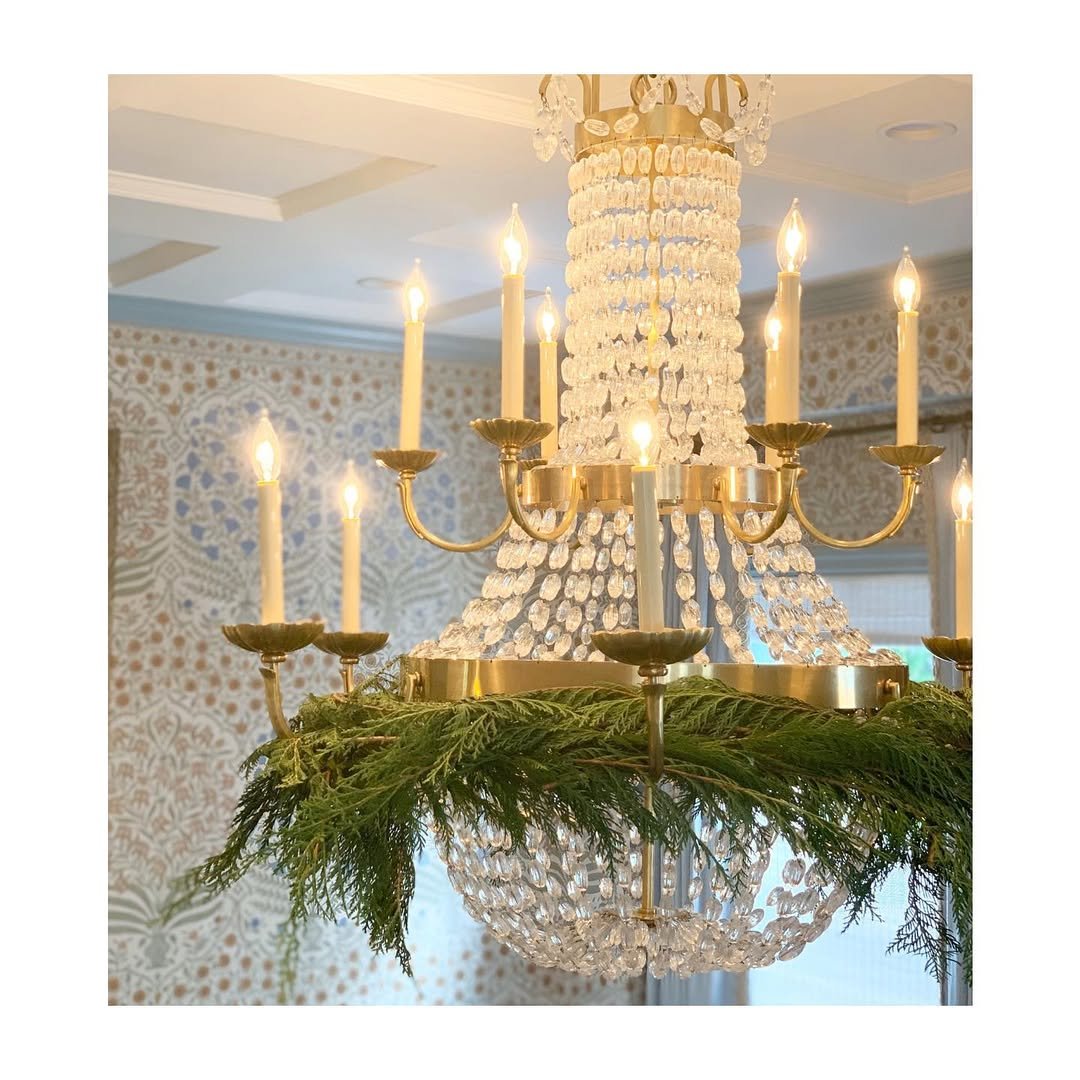
Just a few cedar branches tucked around the base of this crystal chandelier’s brass ring, nothing hanging, nothing wrapped around the crystals themselves. It works because crystal chandeliers already do the sparkle and shine job on their own, so the greenery only needs to soften the hard metal ring where it meets the crystal drops. Piling on ornaments here would actually compete with the chandelier’s own detail instead of adding to it. If you own a crystal piece, this is the lightest possible touch that still reads as decorated.
The Fixture That Decorates Itself
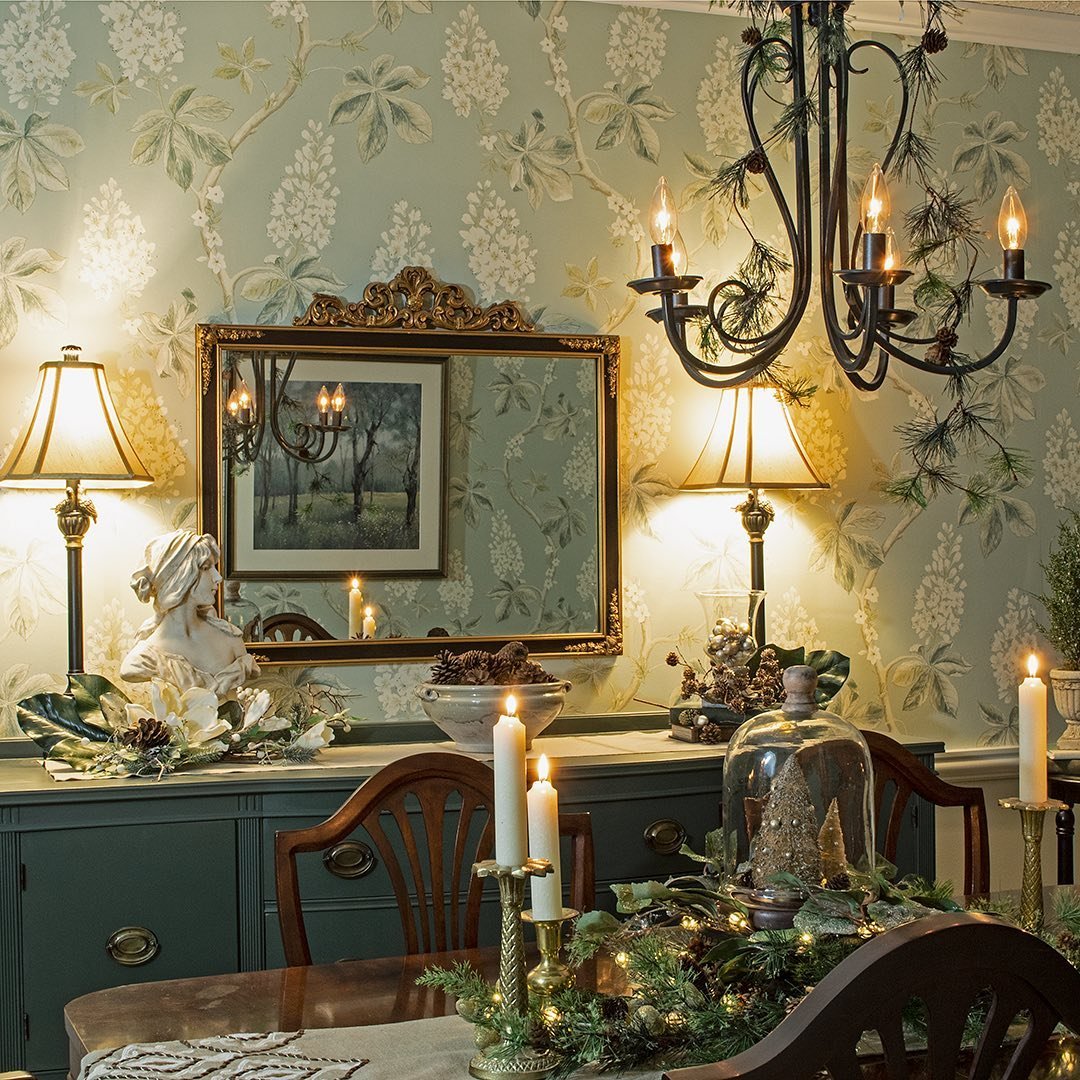
Small pine sprigs and pinecones get tucked directly into the curls of this black iron chandelier’s arms, so the fixture’s own shape does most of the visual work. It works because iron chandeliers with scrollwork or curved arms already have built-in spots to wedge a sprig without wiring anything, which makes this the lowest-effort option here. The green picks up the same tones as the wallpaper’s leaf pattern behind it, so the whole wall feels coordinated without anyone having matched paint swatches. If your chandelier has any curve or twist in the metal, look for the gaps first before you reach for wire.
Fresh Leaves Instead of Faux Pine
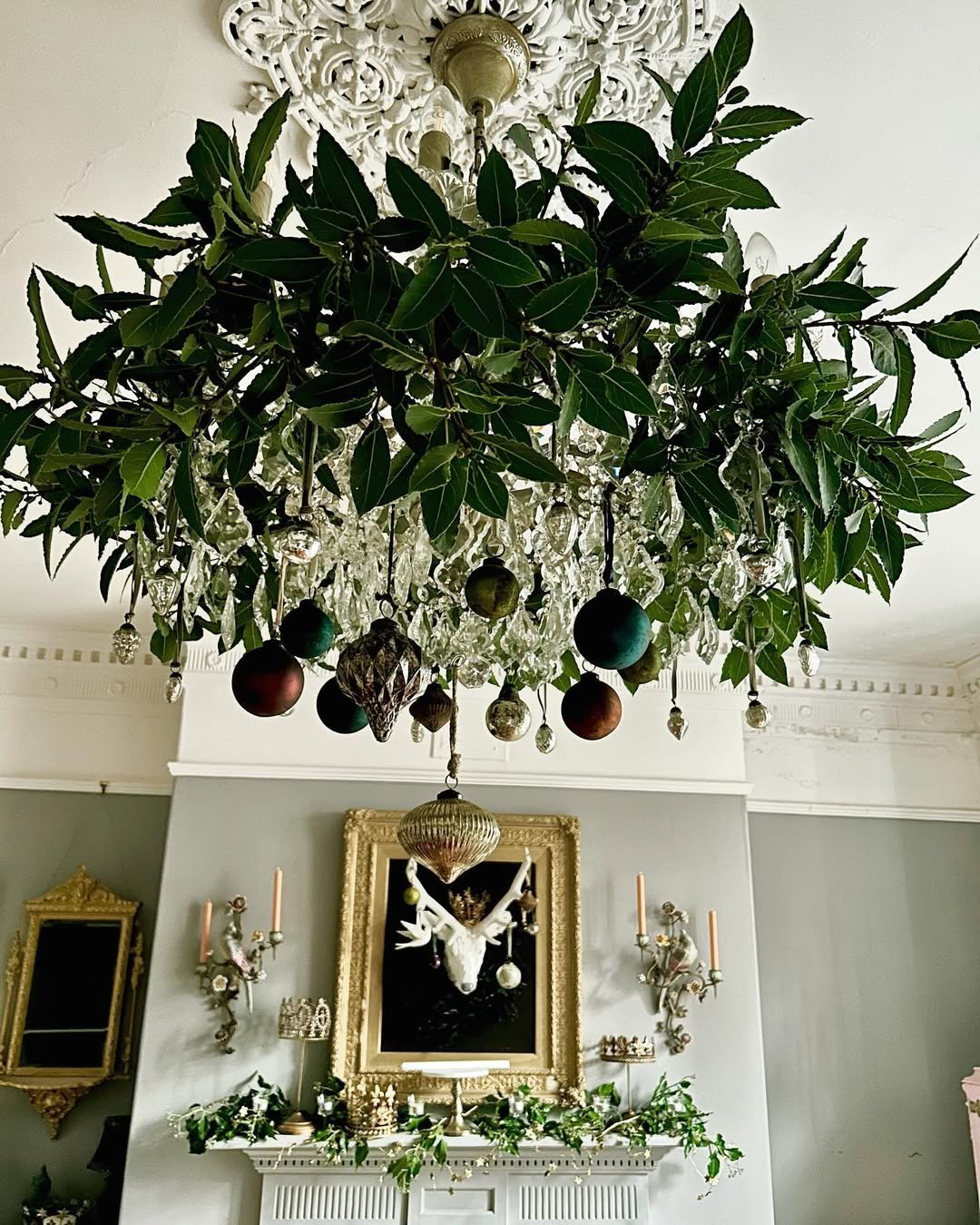
A dense dome of fresh bay leaf branches covers this crystal chandelier almost completely, with jewel-toned glass ornaments and crystal drops hanging below in deep teal, burgundy, and bronze. It works because bay leaf holds its shape and color far longer than most fresh greenery, so it looks lush without wilting by week two. The jewel-tone ornaments against all that dark green reads more like an English country house than a typical red-and-gold Christmas look. This one takes real branches and real time, so save it for the main room where people will actually look up.
A Wreath Standing In for a Chandelier
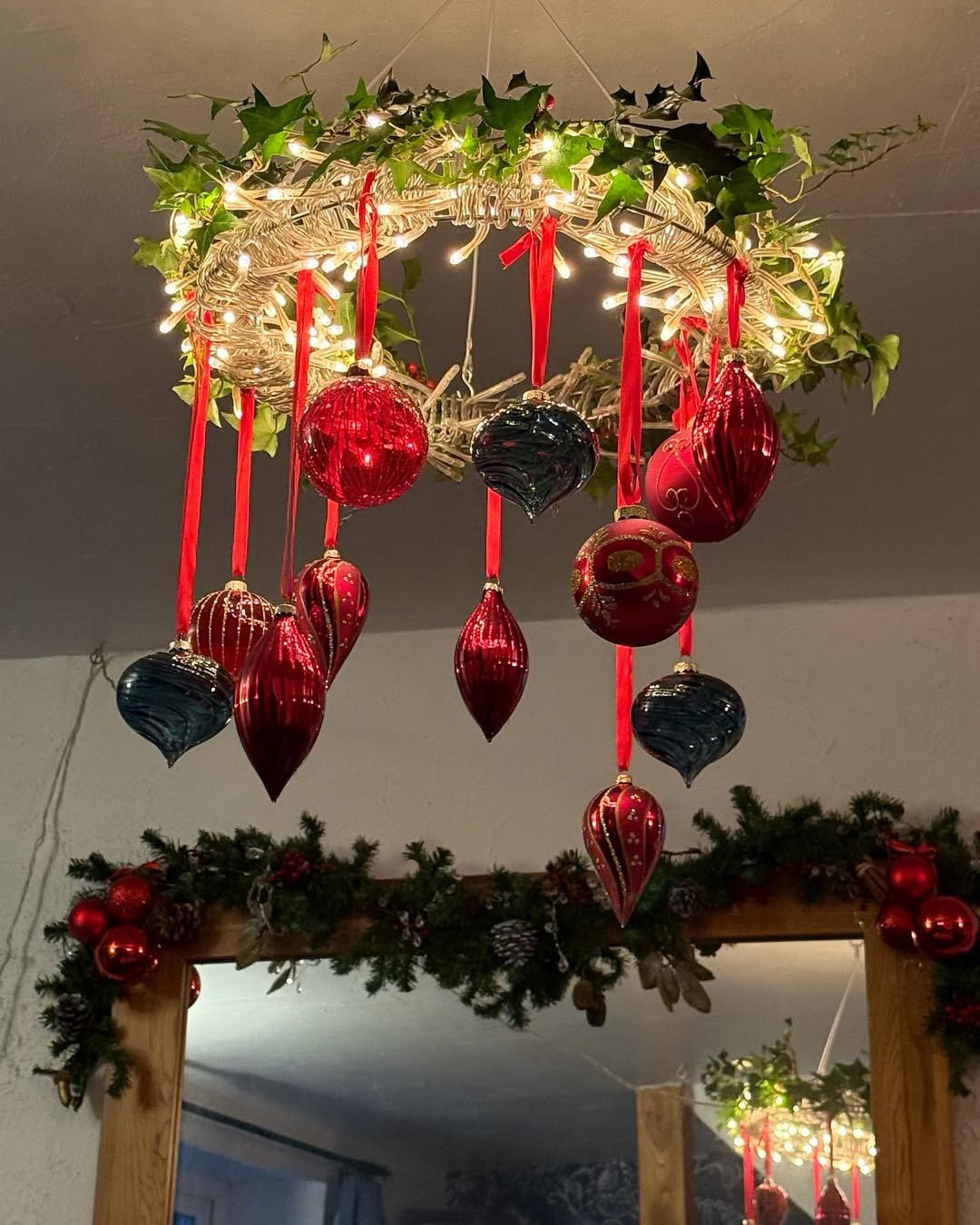
Ivy and warm white string lights wrap a wire ring here, with red and deep teal glass ornaments in different shapes, balls, teardrops, finials, hanging on red ribbon underneath. It works because the ring shape mimics a real chandelier’s silhouette, so it reads as a light fixture even in a spot that doesn’t have one, like over a doorway or mirror. Mixing ornament shapes instead of using all round balls is what keeps this from looking like a string of standard baubles. This is the move if you want the chandelier look somewhere you don’t actually have wiring.
Ornaments Doing the Job of a Lampshade Trim
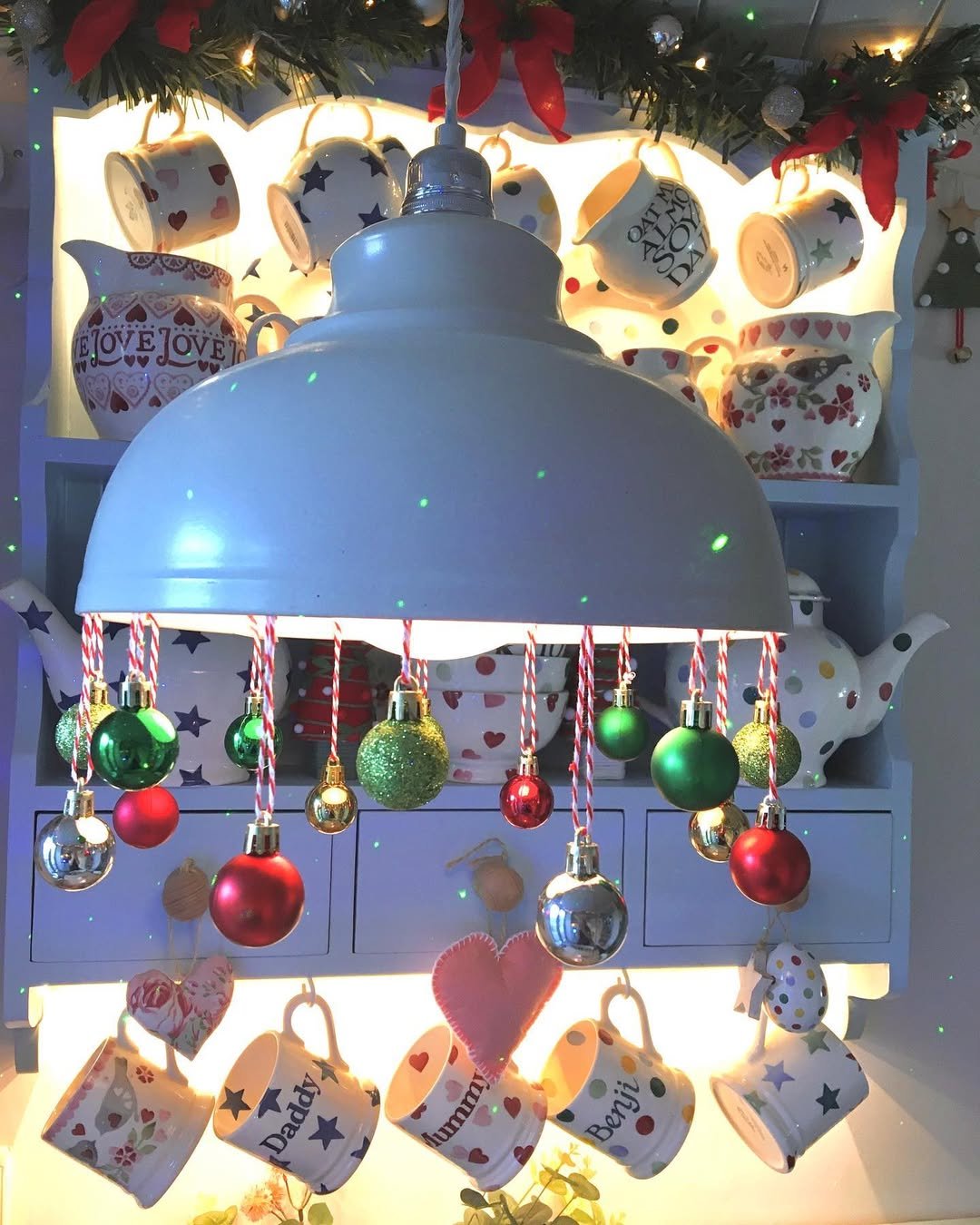
A row of red, green, and silver ball ornaments hangs on red and white string straight from the rim of this dome pendant, turning the bottom edge into a beaded fringe. It works because the ornaments hang at slightly different lengths, which keeps the fringe from looking like a stiff, store-bought trim. The pendant sits in front of an open shelf of collectible mugs and jugs, so the hanging balls also help visually connect the light to the display behind it. This is an easy one to try on any dome or bowl-shaped pendant, since the ornaments just need string and a hook, and these cabinet organization ideas are worth a look if that same shelf needs sorting out.
One Bird Instead of a Full Wrap
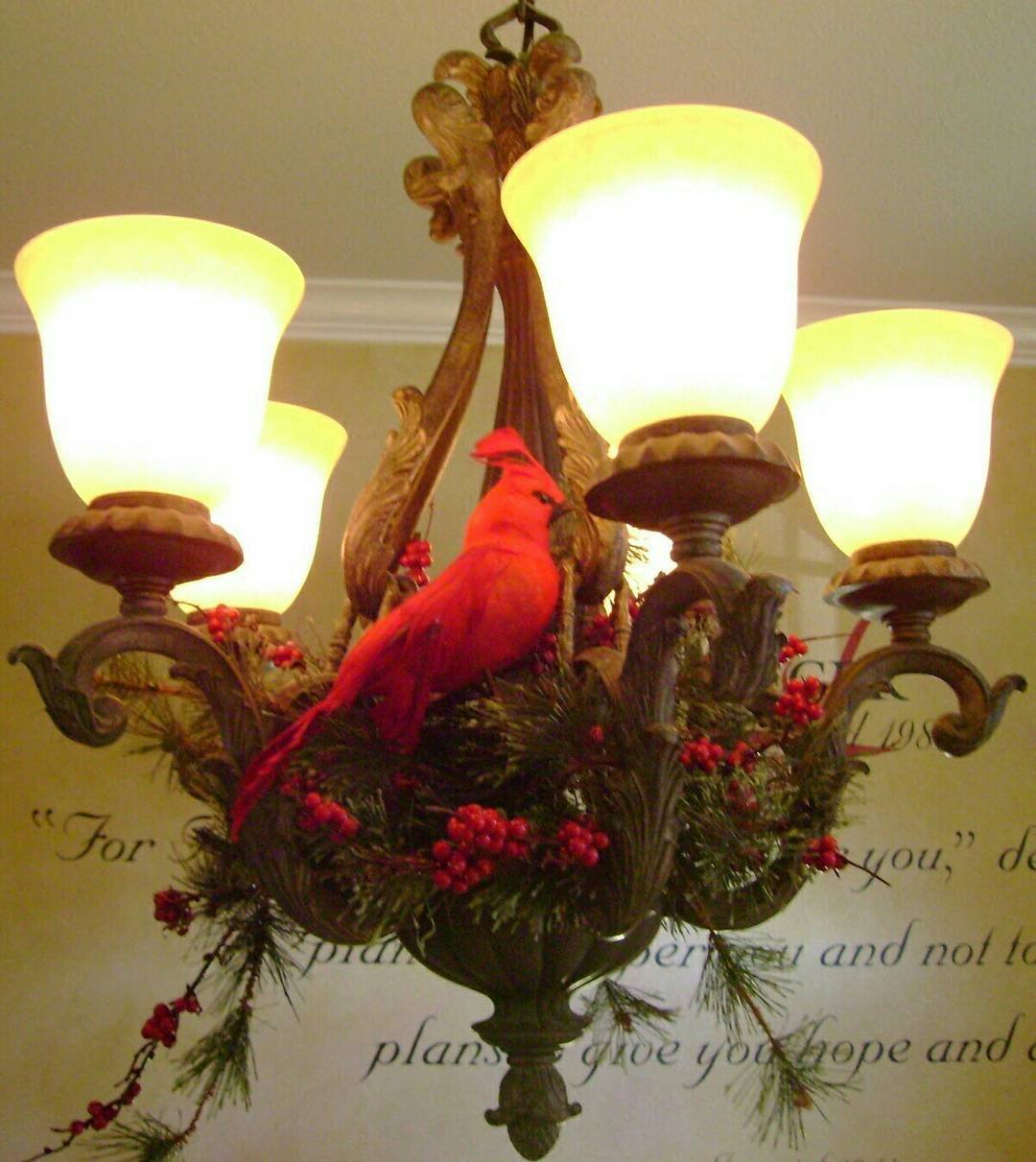
A single faux red cardinal perches in the greenery nest at the base of this traditional brass chandelier, surrounded by pine sprigs and red berry clusters, with no ornaments hanging at all. It works because the cardinal gives the eye one clear focal point instead of asking the room to take in a dozen small details. Berries and pine at the base are enough to read as decorated without touching the glass shades or arms. If you’ve got a traditional chandelier with frosted glass shades in a Victorian-style dining room, the same restraint that works in these Victorian kitchen ideas applies here too.
The Bow Does More Than the Greenery
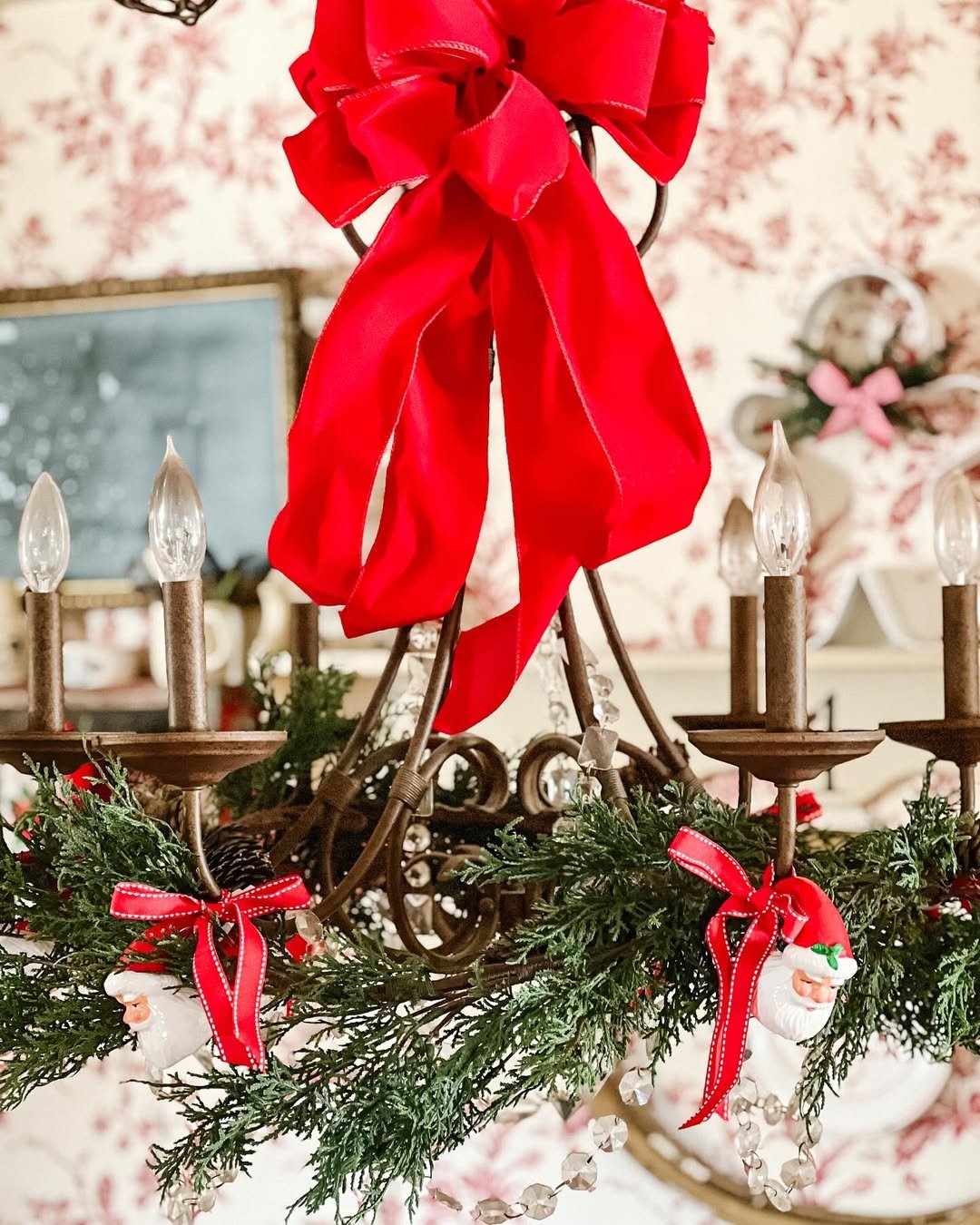
One large red satin bow ties around the chandelier’s center pole, with cedar and small Santa face ornaments tucked into the arms below on thin red ribbon bows. It works because the bow is scaled up bigger than what most people would think to use, and that oversized size is exactly what makes it read from across the room instead of getting lost. The vintage Santa ornaments add a collected, not-bought-this-year feeling that a plain ball ornament wouldn’t give you. Go bigger than feels reasonable with the bow, since a small one disappears against a busy chandelier.
Stars on Ribbon Instead of Ball Ornaments
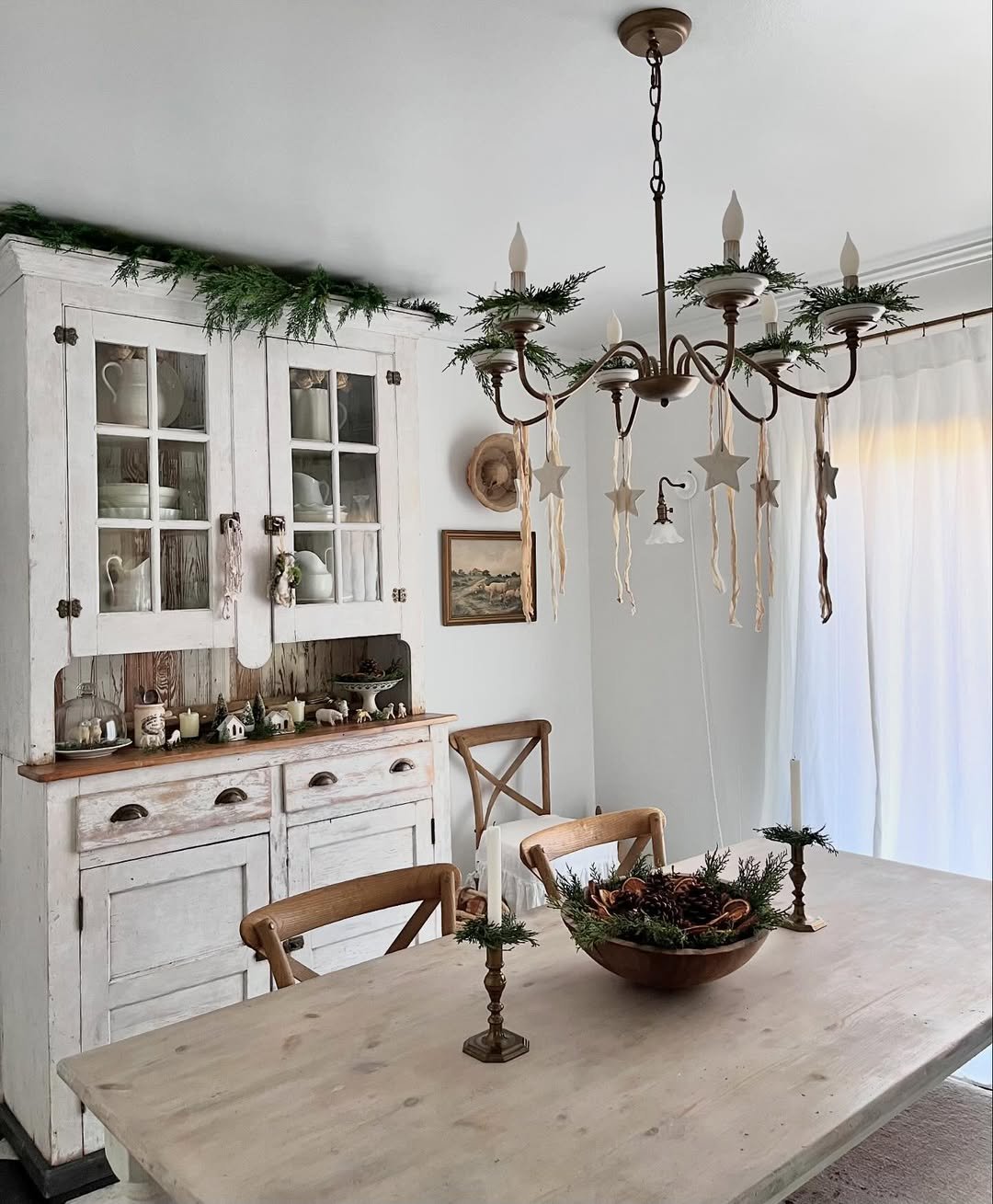
Small cedar wreaths sit on top of each candle cup here, while wooden star cutouts hang below on long strips of torn fabric ribbon in cream and tan tones. It works because the torn fabric strips move and catch light differently than a stiff ribbon would, giving the whole piece a soft, handmade look instead of a manufactured one. Stars instead of balls also fit a farmhouse or vintage room better, since they skip the shiny, formal look balls usually bring. This is worth trying if your dining room already leans neutral and worn-in rather than polished.
Paper Ornaments Against Deep Wall Color
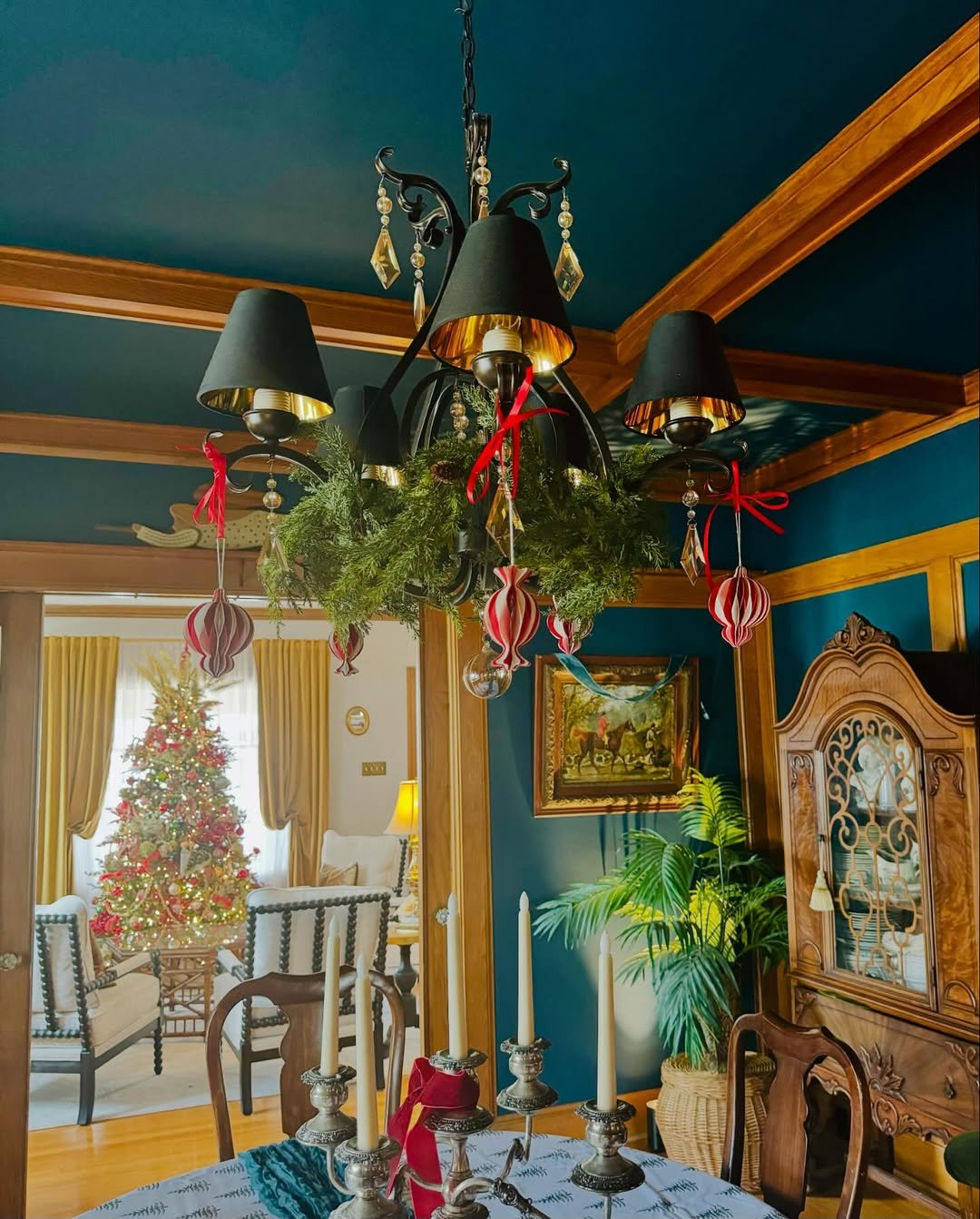
Cedar wraps the center of this black-shaded iron chandelier, with red and white paper honeycomb ornaments and small glass finials dropped on thin ribbon below. It works because the paper ornaments’ matte texture stands out against both the shiny brass details on the chandelier and the deep teal wall color behind it, so nothing gets lost. This room proves a chandelier doesn’t need to be white or gold to take on Christmas greenery, dark-shaded fixtures hold pine just as well. If your walls are a saturated color like this teal, stick to red, white, and gold ornaments so they read clearly against the wall instead of blending in.
Pinecones Standing In for Ornaments
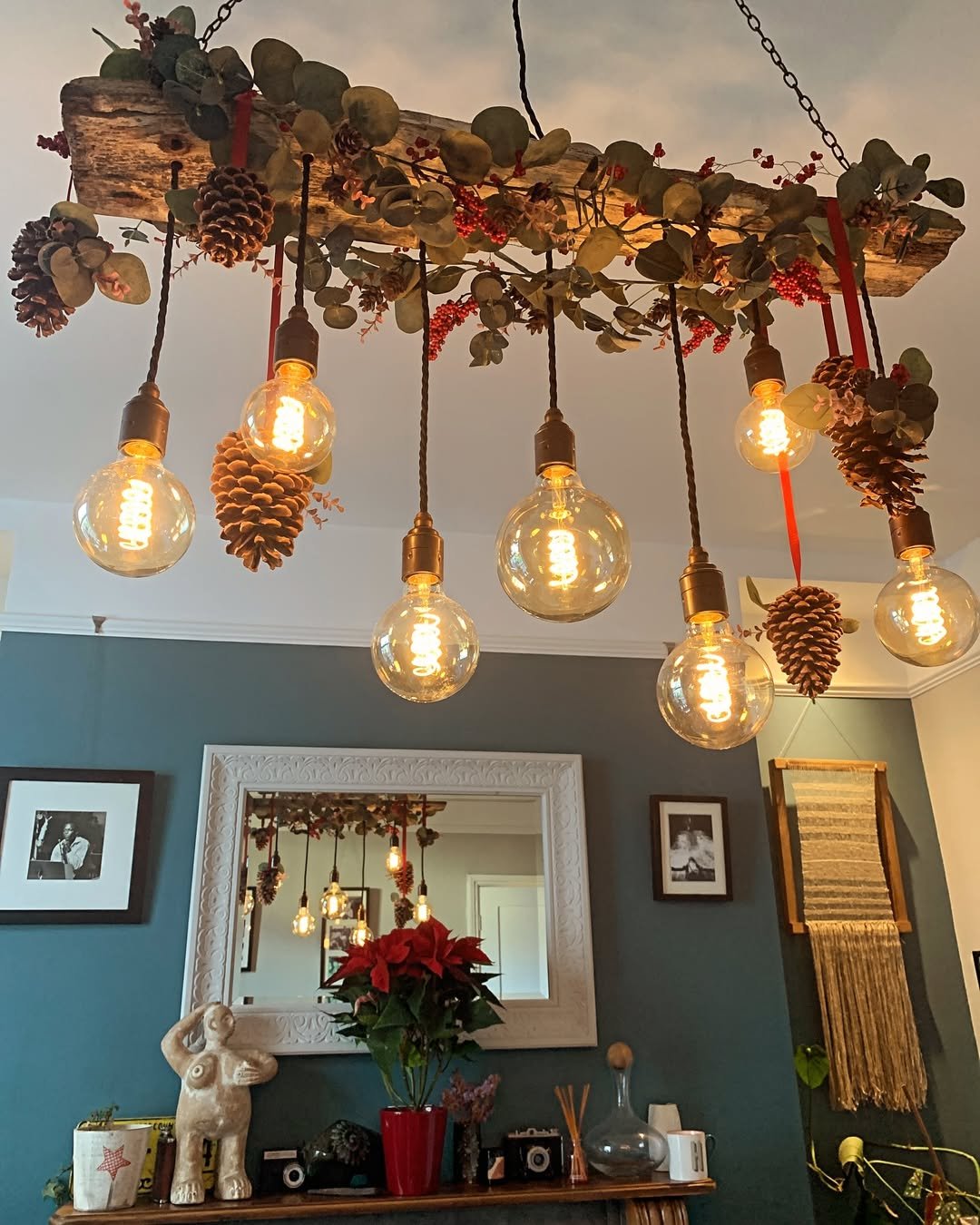
Eucalyptus, red berries, and pinecones get tucked directly onto a reclaimed wood beam here, with bare Edison bulbs hanging below on twisted cord instead of a typical chandelier arm. It works because the pinecones and berries do the seasonal work while the bare bulbs stay industrial, so the fixture doesn’t turn overly sweet or traditional. This is the option for anyone whose current light is already a beam or bulb-style fixture and doesn’t want to fight that shape by adding classic ornaments. Tuck the pinecones into gaps in the greenery rather than hanging them, so they read as part of the branch instead of an add-on.
The Full-Coverage Version for a High Ceiling
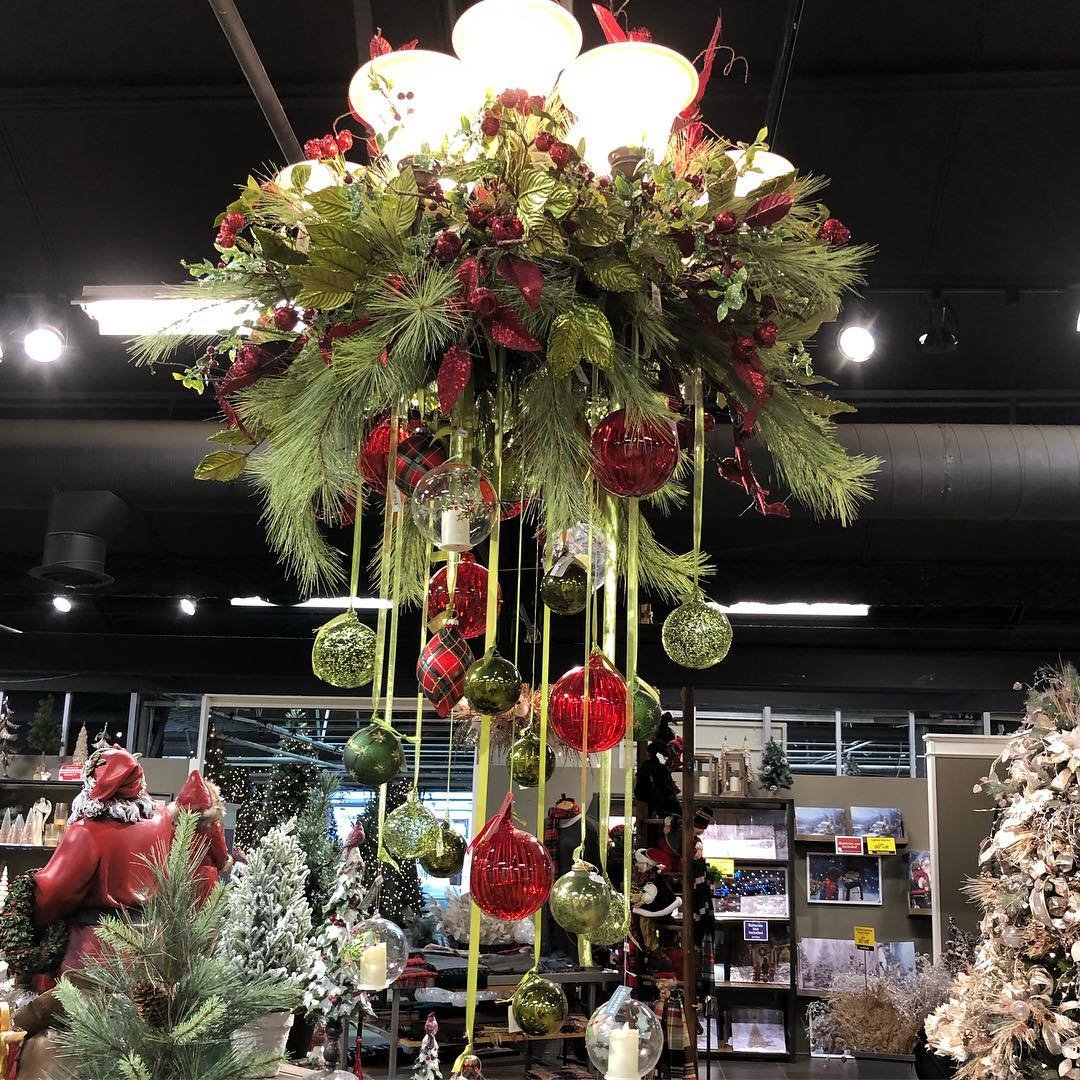
Frosted pine, red leaves, and berry clusters completely cover the top of this flush-mount fixture, with red and green ball ornaments and plaid balls dropping down on long ribbon at different lengths. It works because the ribbons are long enough to bring the ornaments down to a height people can actually see up close, which matters in a tall space like this one where the ceiling fixture itself would otherwise sit too far up to register. This is the most built-up option on the list, closer to a floral installation than a simple wrap. Save it for a room with real ceiling height, since the long drops need the space to read as intentional instead of crowded.
When the Room Does the Work Instead
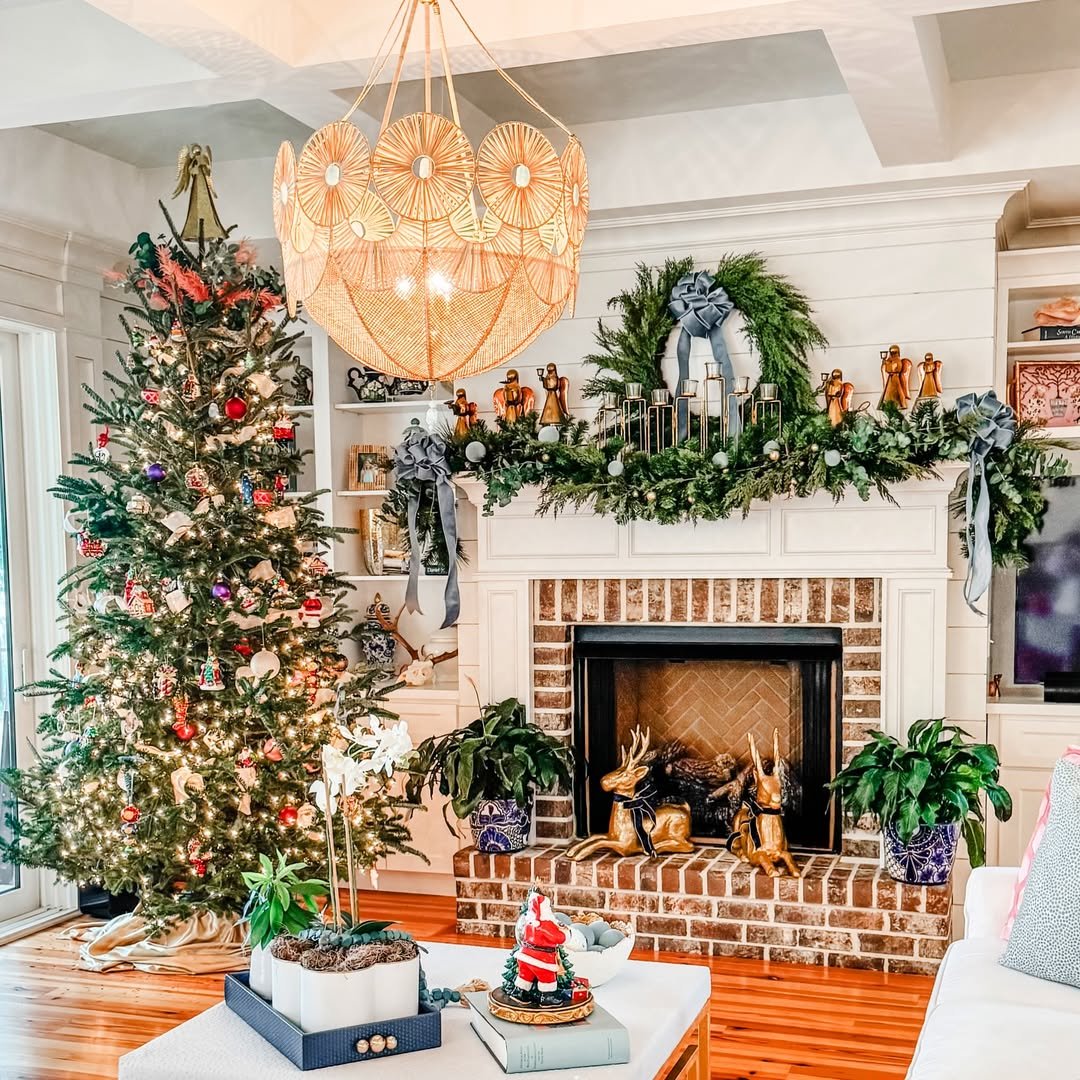
This rattan and macrame pendant stays completely plain, and instead the whole seasonal load gets carried by the tree, the garland-topped mantel, and the ribbon-wrapped wreath around it. It works as a reminder that not every fixture needs greenery wired onto it directly, sometimes the better move is picking one thing in the room to decorate heavily and letting the rest, including the light fixture, stay neutral. A woven or natural-fiber pendant like this one can actually clash with cedar and pine if you try to force greenery onto it. If your chandelier has a strong texture or shape of its own, it’s fine to leave it bare and let a nearby mantel or tree carry the theme.
Mixing Matte and Mirrored Ornaments
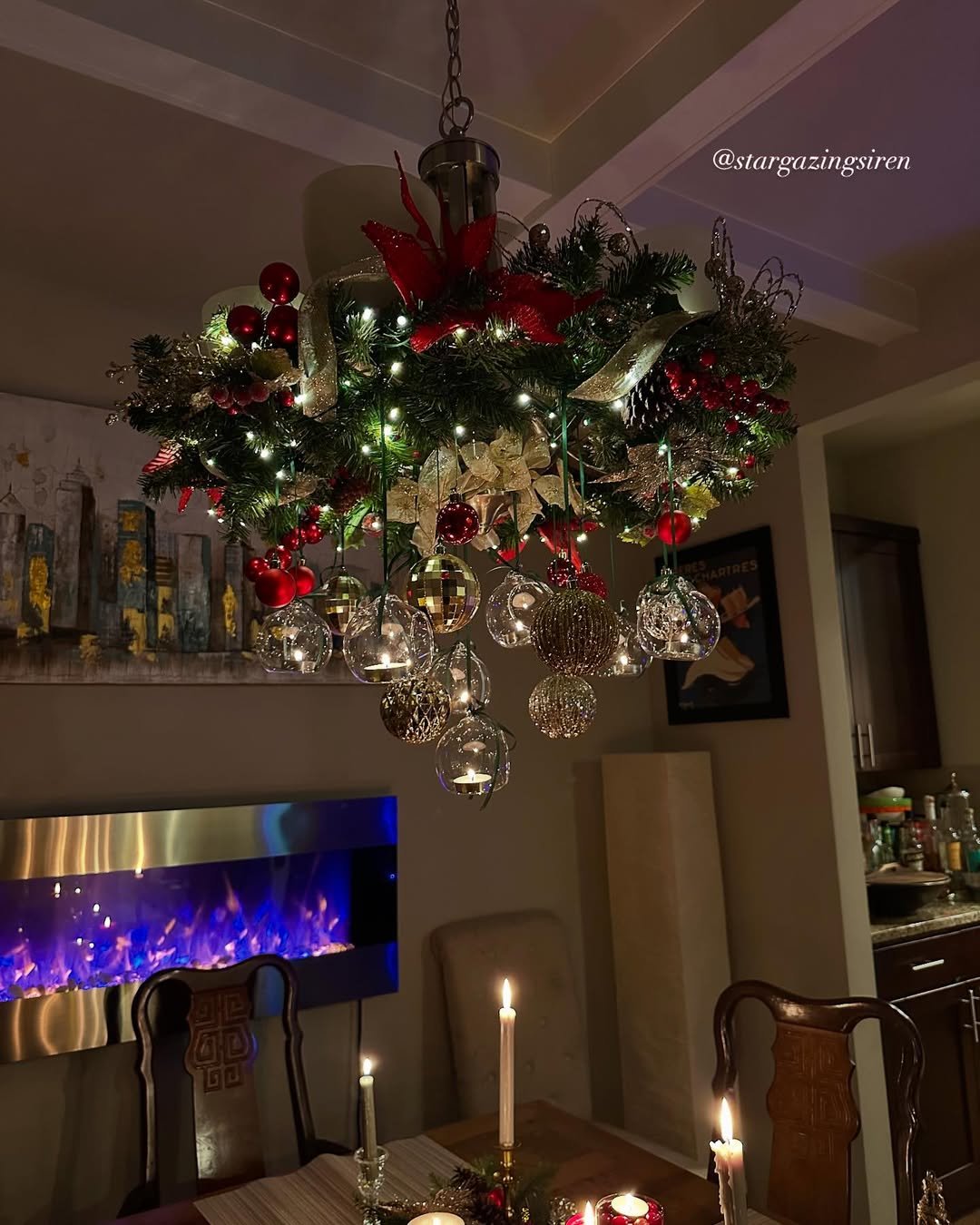
Pine, ribbon, and faux poinsettias build the base here, with a mix of clear glass ornaments holding tea lights, gold disco balls, and red glass balls all hanging together underneath. It works because mixing a matte finish with a mirrored one gives the eye two different kinds of sparkle instead of one flat shine, so the piece keeps catching light from different angles as you move around the room. The tea lights inside the clear glass balls add warmth low down, near table height, where the room’s other lighting usually doesn’t reach. If you’re decorating over a dining table, put the glowing ornaments at the lowest hanging point so they double as ambient light for the meal.
The Cleanest Version of Red and White
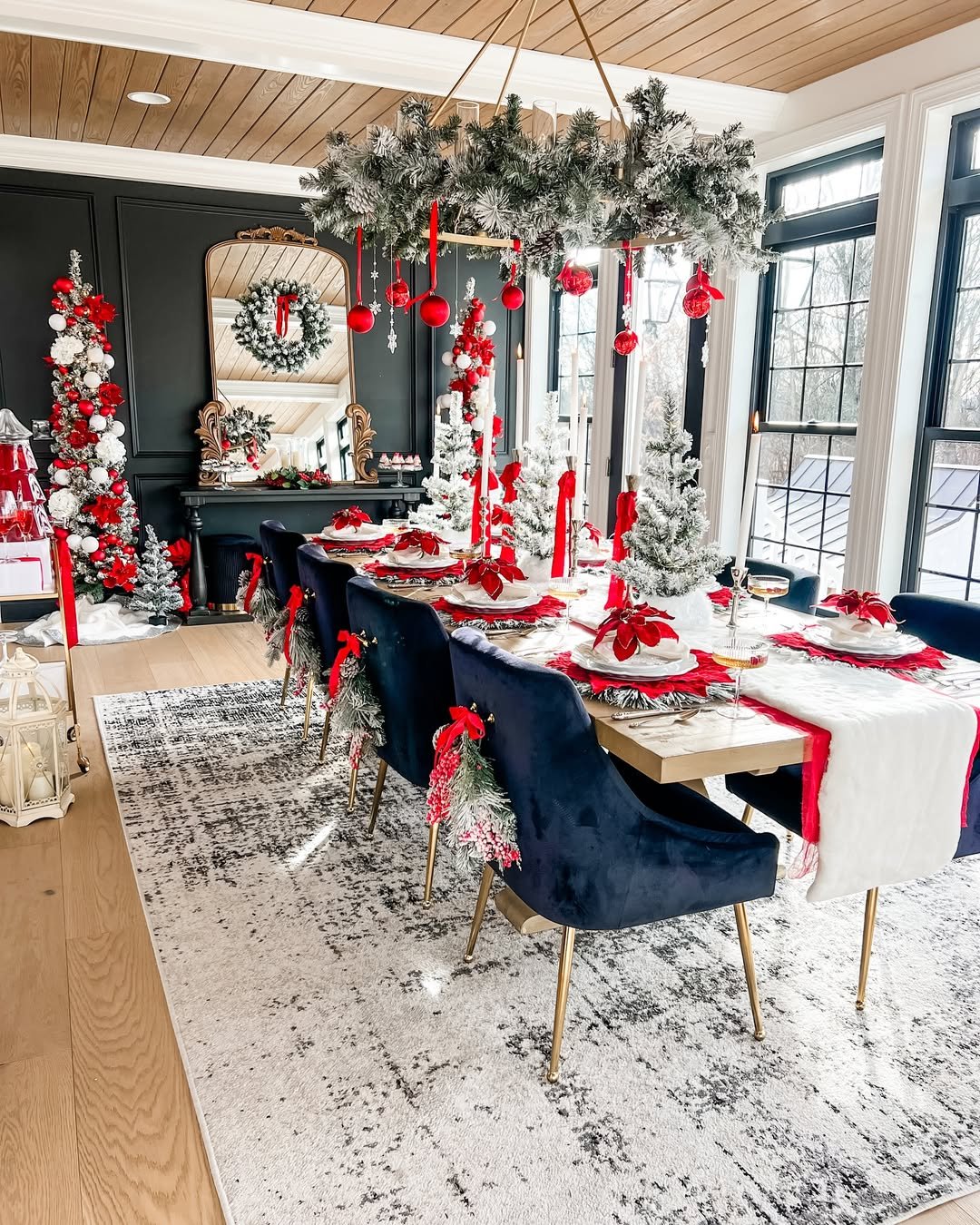
Snow-flocked pine covers the top of this linear chandelier completely, with nothing but plain red ball ornaments hanging below in a simple, evenly spaced row. It works because the flocking and the red balls are the only two elements, so against black walls and a navy and white table setting, the whole thing reads crisp instead of cluttered. Evenly spaced ornaments in one single color is what makes this version feel more polished than a mixed, multi-color drop would. This is the one to copy if your dining room already has a strong color scheme you don’t want to compete with.
Taking the Look Outside
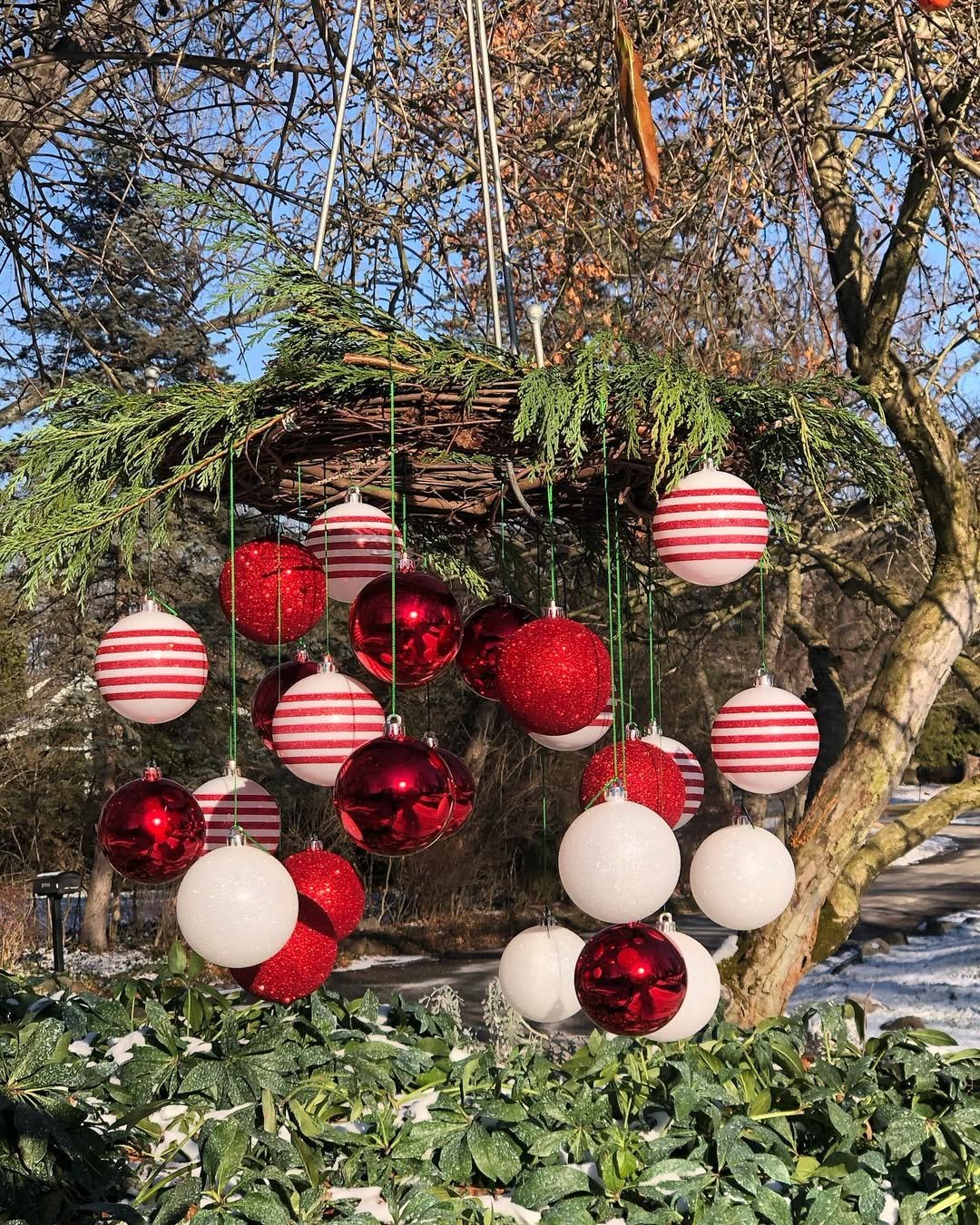
A woven grapevine ring gets topped with fresh cedar and hung with oversized red and white striped and glitter ball ornaments outdoors, suspended from a tree branch instead of a ceiling. It works because it proves this whole styling idea isn’t limited to a dining room, the same greenery-ring-plus-hanging-ornaments formula holds up just as well strung from a tree over a walkway or porch. Using oversized ornaments here matters, since anything smaller would get lost against the scale of the bare branches around it. If you’ve got a covered porch or a tree near your entry, this is how to bring the indoor chandelier idea outside without it looking like leftover indoor decor.

1 thought on “The Ornaments Never Touched a Branch: 20 Christmas Chandelier Decor Ideas Hanging Straight From the Light”